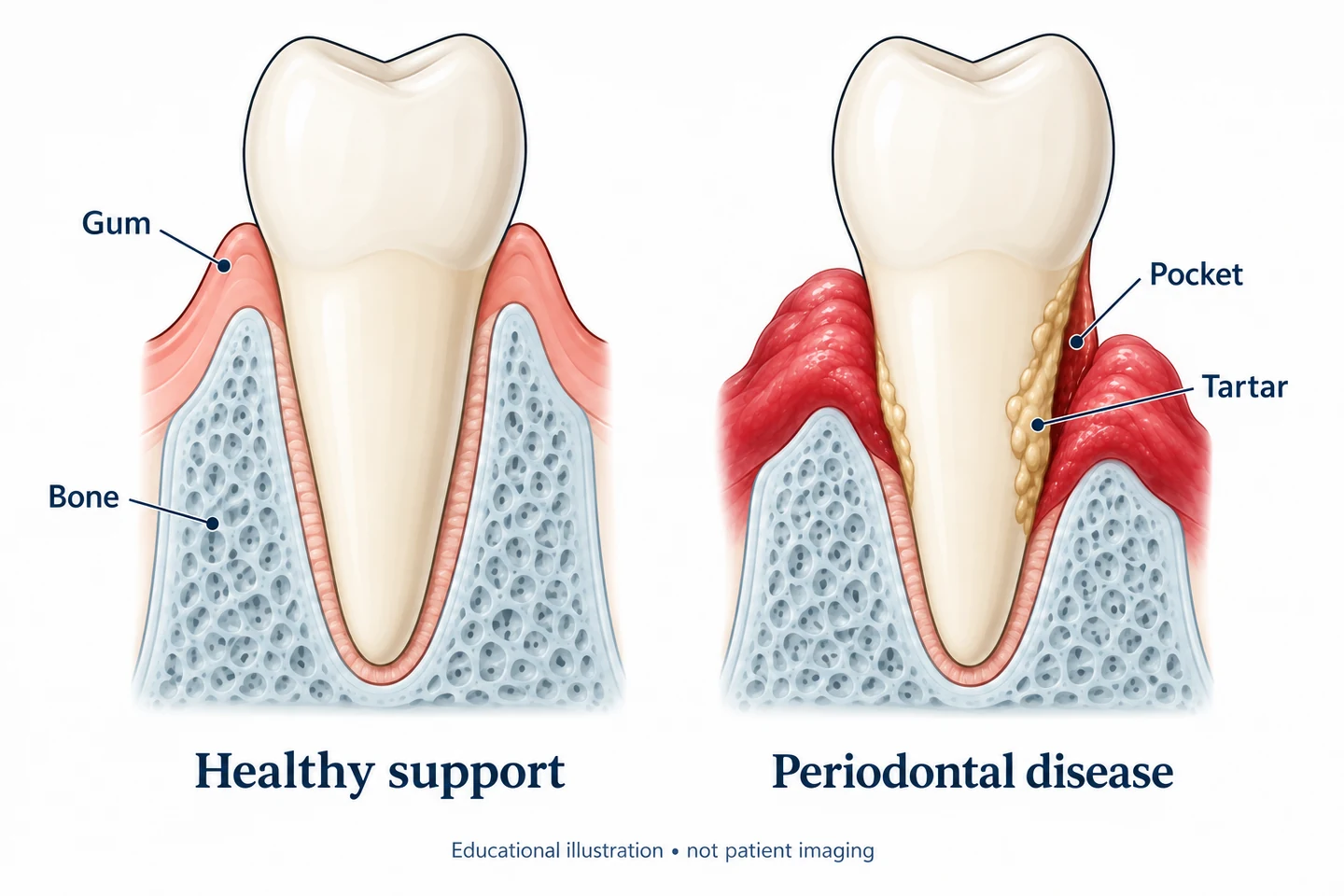
When plaque and tartar collect below the gumline, professional cleaning can help address the infection and support healing.
Ongoing periodontal care helps you look after your gums after active treatment.
A follow up examination helps your periodontist assess your response and decide what comes next.
Medication may be considered alongside periodontal treatment when your individual condition calls for it.
Your periodontist can evaluate how your teeth meet and discuss whether bite related care may help.
A gum graft may be recommended to address recession and provide coverage or additional tissue around teeth.
Regenerative treatment may help address selected areas of bone and tissue loss caused by periodontal disease.
When deeper pockets remain, periodontal surgery may help make affected areas more accessible for cleaning and ongoing care.
Changes in the jaw ridge after tooth loss can affect plans for tooth replacement.
Crown lengthening can expose more tooth structure for a restoration or address the appearance of excess gum tissue.
Removing selected excess gum tissue can change the shape of the gumline when clinically appropriate.
A frenectomy changes a small band of tissue connecting the lip or tongue to nearby oral tissues.
When a tooth cannot be retained, a clear plan can help you understand removal, healing and replacement options.
A socket preservation procedure may help manage changes to the ridge after a tooth is removed.
Some teeth need help becoming accessible for orthodontic treatment.
A fiberotomy may be considered as part of an orthodontic plan for selected teeth.
An unusual area in the mouth may need further evaluation to understand what it is.
Tori are bony growths in the mouth. Treatment may be considered if they interfere with comfort or planned dental care.
Laser technology may be used for selected periodontal and soft tissue procedures.
A surgical laser may be used to treat selected areas of oral soft tissue.
Low level laser therapy may be considered as a supportive treatment option.
A sinus lift may be considered when there is insufficient bone in the back of the upper jaw for a planned implant.
A flap procedure provides access beneath the gums when your periodontal plan calls for surgical treatment.
Discuss evaluation and care options for temporomandibular concerns.
Build a home care routine to support professional treatment.
 CHAMPAIGNPERIODONTICSAND DENTAL IMPLANT CENTER